
AVID ARTIST
PETER J. CHAKOS
“Anyone who wants to get into what I call the big leagues should be editing and learning how to edit on Avid.”
EMMY® NOMINATED FOR:
Mid-Century Modern, “Here’s to You, Mrs. Schneiderman”
CATEGORY:
Outstanding Picture Editing (Multi-Camera) for a Comedy Series
AVID PRODUCTS USED:
Media Composer
FAVORITE AVID TOOLS:
ScriptSync, Animatte, FluidMorph, Multicam, Match Frame, Extend Edit, Audio Scrub, Source-side Waveforms
Combining Emotion and Comedy in a Tribute Episode
In comedy, you tend to want everything to be fast and paced up and in this one, I opened up and let things breathe and sit because our lovely Linda Lavin (Sybil Schneiderman character) passed away during production. That loss and the loss of the character are one and the same for us. It was an emotional show to shoot. We wanted the episode to be extra good for her.
You have to shift gears, get out of your comedy head and stop pulling every line up and not worry about things being fast and just let it play, open things up to make it even more dramatic. The writers did an amazing job writing the line between the emotion and drama of the episode and still being able to make it funny.
You can have them talking seriously about her, like the scene where the character is writing her eulogy and reads it back to the guys and then it's not quite like she really was, and they challenge him on that and that brings out some comedy.
Finding the Editing Rhythm
You want scenes to build and have plateaus and build back up again. You want a rhythm, there's always a rhythm in comedy, and that's essential to the way I work.
That happened in the scene where he's telling the guys what happened and obviously you want to cover the reactions from who he's talking to so we had a three shot, a single of Nathan (Nathan Lane) and two singles of the guys.
But in the second take, which I think I mainly use the second take, it's a mix. I mean, it's always a mix.
We got Nathan in so that when he's turned to each guy, I still have his face dead on because he's so good and I didn't want to be in profile for any of it. A lot of times because you're shooting four cameras at once and I'm watching the quad split, but your eye goes where you think the cut's going to be.
Jimmy (James Burrows, director) likes to shoot pickups on the fly, which I love because this show is 98% in front of the audience. We pre-shoot very little. It's only for things that we couldn't do in front of the audience for one reason or another, a special effect or a complicated dance sequence. We do it in front of the audience and it's so much better because when you watch the performances, you can see the light in the actors’ eyes when they're amped up and there are people there to laugh and respond or not laugh and respond. That tells you if something's working or not. If they don't laugh and they were supposed to laugh, then the writers have to go in and write new jokes. Five minutes later, we're shooting the scene with alternate jokes that were just written on the fly, and the actors have to memorize those.
Tools of the Editing Trade Chakos Swears by
Personally, if I happen to be so lucky and fortunate to take home the Emmy statue, then my two sons will have a problem when I pass on who gets three and who gets two.
One thing you learn is that you're not always right and that every edit is an experiment. You're looking for the best way to do something and you don't always find the best way. That's why it's a collaborative industry. Somebody else is like, ‘What if we did this and you're like, ‘Ah, that's a good idea.’
Media Composer is my tool of choice because it is conducive to the way I edit. I like to mark precise ins and outs and lay each cut in individually. Unless I get lucky with a chunk and I can just switch the cameras and keep that section. The other thing that's imperative for me is ScriptSync. I cannot imagine having to type in time code again or scroll and look for a line where I can just click on it and have all three takes pop up and play them in sequence. That was a godsend. Once I used it, I was never going back. It’s a benefit with multicam being able to look at multiple takes, being able to run and loop through to find your best takes. I'll click on each one individually sometimes and see how the next five lines play out rather than take time to select them to be looped. It's so much faster than looking for a line any other way. Comping in other stuff or taking something out or using any tools like Animatte or FluidMorph help save time. My assistant, Armen Gasparian, does the Animattes for me. I show him what I need to take out and he does it. That way I can just keep working.
The customization of Avid is great. For the function keys, I have the Match Frame edit, I have the Add Edit, I have Extend Edit. I have a subclip hot key. I created, because of the latest version, a hot key to turn audio scrub on. Because I need that. I like the newest feature, the waveform on the source side which is great when you're replacing dialogue or doing a little more complicated audio edit where you want to be precise.
An Accidental Editor
I became an editor accidentally. I'm working on Cheers as a PA (production assistant) and I'm a post-production supervisor supervising edit sessions that are like the online edit, color and placement of credit and things like that. I wanted to talk to the editors in those sessions more knowledgeably. So I took an editing course. Being computer literate, it was easy for me to learn and by the second week, I was helping teach. They were like, ‘Are you sure you've never done this before?’ I decided, ‘Well, maybe I'm good at this.’ I went back to Cheers and over a weekend cut an episode that our editor directed. I told him, ‘Hey, take a look at this when you get a chance.’ Five days later, we're walking on a lot and he goes, ‘So you want to be an editor?’ I said, ‘I don't know.’ And he goes, ‘Well, I think you have great instincts and you should do this.’ A year-and-a-half later, I edited half of a one hour episode of Cheers called “An Old-Fashioned Wedding” which was Woody (Woody Harrelson) getting married. That episode was nominated for an Emmy. So that started my career slowly. I eventually got to a good place.
On mentorship, my door is always open. I've had people come in and sit for a day or week and just watch the process. I've always been open to that. You can come and watch, ask me questions. As long as you don't slow me down.
What I like about being an editor asking myself what makes this scene work. There are always problems. There'll be a gross mismatch, or we leave the blocking loose. An actor will end up in a different place slightly but enough to be noticeable. I like to figure out those problems, to switch hats and tell the story in a shorter period of time.
How to Get into the Editing Big Leagues
Anyone who wants to get into what I call the big leagues should be editing and learning how to edit on Avid. I know that there are other systems out there. I don't know of many big projects that are done on those other systems. If you're going to be doing a network type show or for a major streamer, they're all done on Avid. I recommend learning Avid. It's not hard to learn.
About the Editor
Peter J. Chakos is an award-winning editor and producer of half-hour comedies. Born on the south side of Chicago, he and his family moved to Orange County, California, when he was 16. He has resided in Los Angeles for over 30 years. His television career began on Cheers where he started as a production assistant and left as an Emmy nominated editor. He has been nominated three times for the ACE Eddy and took home the prize for Will & Grace in 2004. He also garnered twenty-seven Emmy nominations with four Emmy statues for The Big Bang Theory, and a nomination for a 2025 Emmy for Outstanding Multi-Camera Picture Editing for a Half-Hour Comedy for Mid-Century Modern, on Hulu. Peter has edited and produced over 50 pilots including, Caroline in the City; Dharma & Greg; Two and a Half Men; Mom, Mike & Molly; Two Broke Girls, B-Positive and Bob❤️Abishola. He has two sons at University, John and Niko. And yes ladies, he’s single.
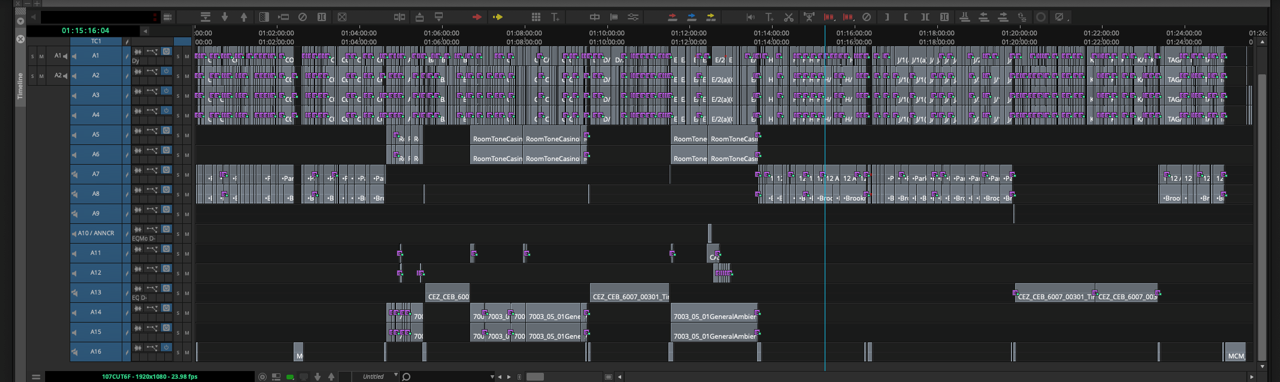
Peter J. Chakos shares his Avid Media Composer timeline for Mid-Century Modern, “Here’s to You, Mrs. Schneiderman”

Email Preferences | © 2026 Avid Technology, Inc. | Terms & Legal | Privacy


