
AVID ARTIST
EVAN WISE, ACE
“Every editing system wishes they could have Avid's Trim Mode.”
EMMY® NOMINATED FOR:
Chimp Crazy, "Gone Ape"
CATEGORY:
Outstanding Picture Editing for a Nonfiction Program
AVID PRODUCTS USED:
Media Composer, Avid NEXIS
FAVORITE AVID TOOLS:
Trim Mode, Asymmetrical Trim, ScriptSync
Finding Balance in Emotional Footage
All the scenes with chimpanzees were challenging to cut because it’s inherently sad when you have a chimp in a cage. We were mindful of where we placed them in the show because we didn't want to have 20 minutes of sad footage and then the audience says, ‘I don't want to watch this,’ and they turn it off. We paid attention to where those scenes went, how long they went, and the music we used because it's easy to push it over the emotional edge where someone gets turned off. But you also don't want to pull back too much to take away the authenticity of what's generally a sad thing.
Humanizing Chimps Through the Cut
When I first started looking at raw footage for Chimp Crazy, I was surprised how human-like chimpanzees are. I didn't have a lot of knowledge about them. I've never seen one in person. I thought they were like dogs that were smarter. When I saw how they react and interact with humans. I realized, ‘Oh, my God, they are almost people.’ We treated them like such in the cut; their facial features are so much like ours. If you cut to a close up of a chimpanzee's eye, it has the same emotional effect as if you're cutting to a human's eye. When we needed an emotional moment with the chimpanzee, we edited them like they were people.
With a docuseries like this you don't know what you're getting until you see the footage so it's all building as you're setting it. I try to lead with action like if there's ever something happening let that happen first. Let the viewer absorb it. If you can experience something do that first rather than tell someone about it. Tanya is going through a lot emotionally as well so that's going to help drive how you edit. When I'm starting a scene I'll think about what the overall emotion is or how I feel about this footage, and how can I make the audience feel the same thing.
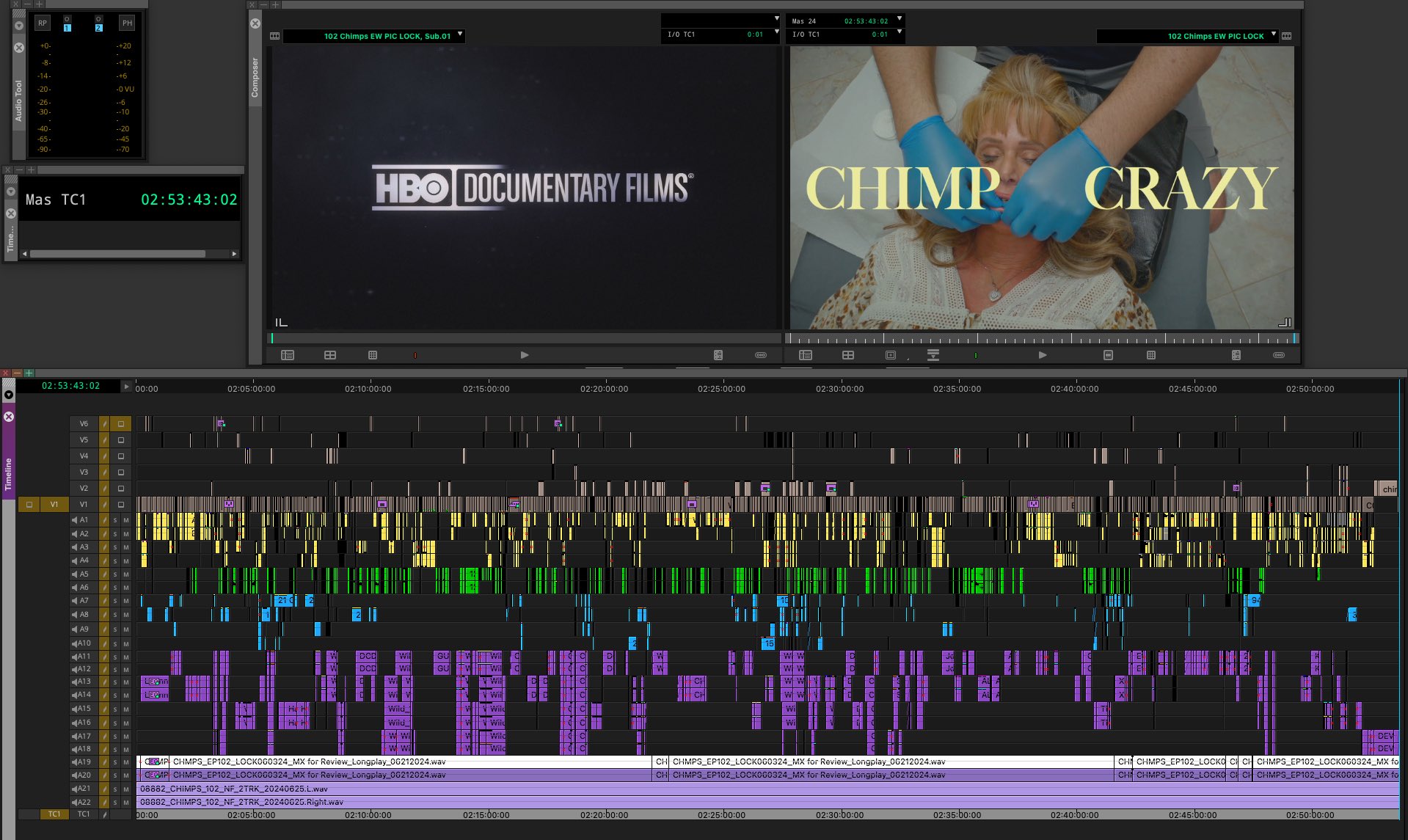
Evan’s Avid Media Composer timeline for Chimp Crazy
Media Composer was critical to our project because we had five editors at our highest point and there's no software that works better. There's no better shared ecosystem than Avid and NEXIS. Having a rock-solid stable system that we could count on to not crash and that was easy to pass things off between each other was critical for us. Even with NEXIS and everybody being remote we were able to seamlessly collaborate, share sequences and bins, and collaborate perfectly.
The biggest tool I use in Media Composer is Trim Mode. Every editing system wishes they could have Avid's Trim Mode. I do these crazy asymmetrical trims with tracks going this way and tracks going that way. Your five-minute move takes you 90 seconds. ScriptSync is also huge because we did 15 interviews with Tanya and they were able to merge all ScriptSyncs into one so if we needed to see if she said anything across her interviews we just went to one document and you could search so you didn't have to open up individual ones and waste time.
Magic in the First Frame
What sets our work apart in Chimp Crazy is our story structure. We have a unique way to tell this story and it's not always linear. We set the episode cliffhangers almost right away and they never changed. That's how good they are. Building up to that, having the credits roll and every audience member saying, ‘I can't believe they're making us wait till next week.’ That's what I'm most proud of.
One reason Chimp Crazy has been successful is because we had so much time to try stuff. We were never pressured to rush a cut or hit an air date. You can't do that on every show because time and money are real things and we're working at the intersection of art and commerce. We got to explore every avenue and try crazy things, even if we knew they probably wouldn't work. But if they did, they would be great. We had real freedom to experiment and be creative.
I knew that this was a special project from the first frame of footage I saw. Tanya is a magnetic presence and the story is so wild and unexpected. A soon as I saw the sizzle for this I said, ‘I want to work on this, I need to work on this.’ There's a feeling you get when you're working on something and you know that it's kind of magical. I definitely had it and I think all my co-editors had it as well.
I felt supremely confident in the work but the Emmy nomination is always a surprise because you never know how those things go and how voters feel.
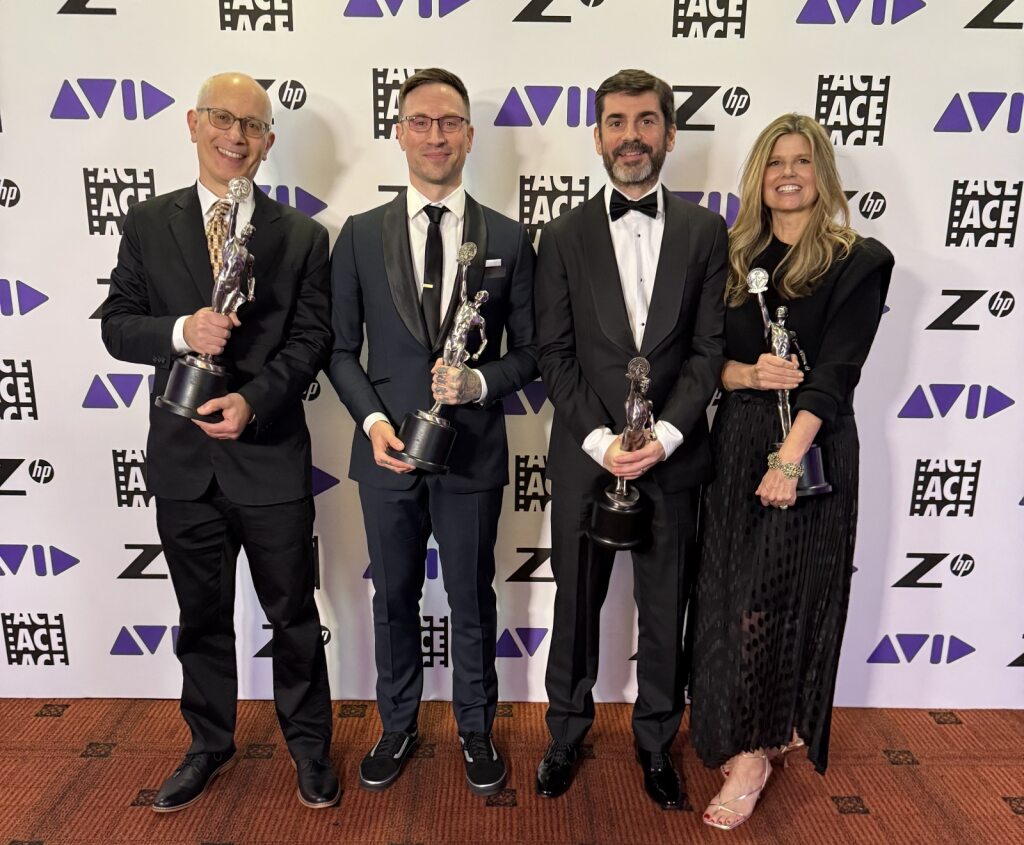
The editing team of Chimp Crazy: Gone Ape win a 2025 ACE Eddie Award for Best Edited Documentary Series
Tips for a Long Editing Career
I first started using Media Composer in college. Everybody had to take intro to editing classes. I got an internship at a post house. I looked around and said, ‘Oh, these are the people who get paid to edit and they're using Avid so I better learn how to do this.’ Once I started getting comfortable with it I realized that it was intuitive. Now it's just the way my brain works.
My biggest documentary influence is Joe Berlinger and Bruce Sinofsky because I watched Paradise Lost when I was 17 and that's what made me realize I wanted to make documentaries and that people wanted to watch documentaries. It was on HBO and I was shown it in a film class in high school. Everyone was riveted by it and I realized there's real power in this art form and that's what I wanted to do.
Edit with Passion and Purpose
Chill out when you get notes. It's not the end of the world. Don't take it personally and figure out what you can learn and then internalize those notes. Often the note isn't straightforward. There's what I like to call the note behind the note, where they don't necessarily mean exactly what they say but there's something happening in that moment in the footage or in the show that is causing them to react.
Get a comfortable chair and exercise because you're going to get paid to sit down forever and you can go to waste. Don't let that happen.
When I first started I was trying to please the person that hired me. Now I know that I need to love it, too. I need to make something that I think is great. You have to heed their advice and you are delivering a product to somebody else but I also have to think that it's cool, that I'm not just trying to make someone else happy. I'm trying to make us both happy.
About the Editor
Evan Wise, ACE, is a Primetime Emmy–nominated and ACE Eddie Award–winning documentary filmmaker. He served as writer, producer, and supervising editor on HBO’s Chimp Crazy, hailed by The New York Times as “jaw-dropping.” The series earned him two Primetime Emmy nominations and his first ACE Eddie Award for Best Edited Documentary Series. Wise’s real-time shaping of the Chimp Crazy narrative helped make it HBO’s most-watched docuseries since 2020. The show was spoofed on Saturday Night Live, featured on Jeopardy!, and sparked renewed efforts to ban primate ownership in the U.S., prompting Congress to reintroduce the Captive Primate Safety Act. Previously, Wise was a lead editor on HBO’s Q: Into the Storm, earning his first Primetime Emmy nomination. He received three News & Doc Emmy nominations as producer and supervising editor on Showtime’s The Circus, along with an ACE Eddie nomination for Best Edited Non-Scripted Series.
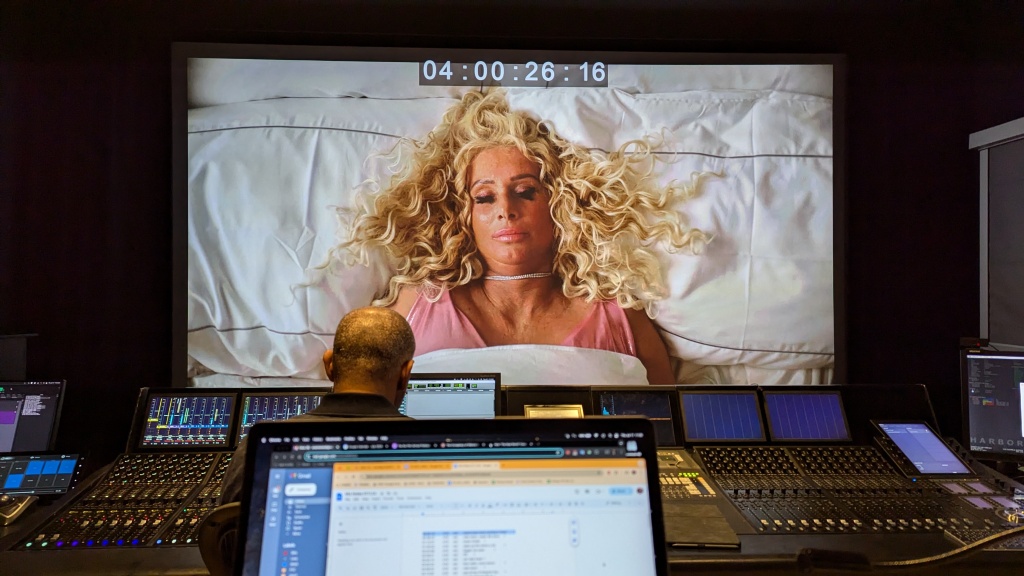
On the sound mixing stage for Chimp Crazy

Email Preferences | © 2026 Avid Technology, Inc. | Terms & Legal | Privacy


